
Cats and dogs are among the most popular pets in the world, and many households choose to keep both animals together. While living with multiple pets can be rewarding, it can also create feeding challenges. One common concern among pet owners is whether cats can safely eat dog food. It is not unusual to find a curious cat sneaking a few bites from a dog's food bowl, especially when both pets are fed in the same area.
This situation often raises an important question: is it harmful for cats to eat dog food? The answer depends on how often it happens, how much dog food is consumed, and whether the dog food replaces the cat's regular diet. While an occasional bite of dog food is generally not dangerous, feeding dog food to cats regularly can lead to serious nutritional deficiencies and health problems.
Understanding the differences between feline and canine nutritional requirements is essential for every pet owner. Cats and dogs may appear similar in some ways, but their dietary needs are very different. This article explores whether dog food is harmful to cats, why cats require specific nutrients, potential health risks, and what pet owners should do if their cat frequently eats dog food.
Table of Contents
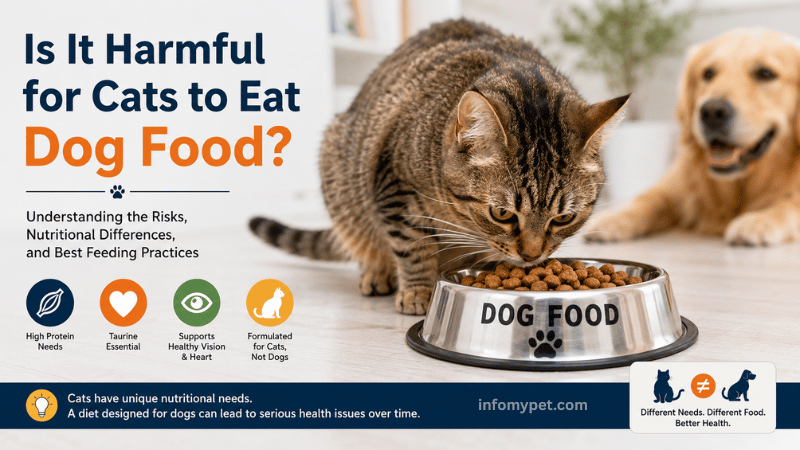
Is It Harmful for Cats to Eat Dog Food?
Understanding the Difference Between Cats and Dogs
To understand why dog food may be harmful to cats, it is important to recognize the biological differences between the two species.
Cats are classified as obligate carnivores. This means they rely heavily on nutrients found in animal-based protein sources to survive and thrive. Their bodies are specifically designed to process and utilize nutrients obtained from meat. Cats require certain nutrients that cannot be produced naturally by their bodies in sufficient quantities.
Dogs, on the other hand, are considered omnivores. They can obtain nutrients from a wider variety of food sources, including meat, vegetables, grains, and fruits. Because of this dietary flexibility, dog food formulations differ significantly from cat food formulations.
As a result, food designed for dogs does not provide the complete nutritional profile that cats require for long-term health.
Can Cats Eat Dog Food Occasionally?
In most cases, a cat eating a small amount of dog food occasionally is not a cause for concern.
If your cat sneaks a few bites from your dog's bowl once in a while, it is unlikely to experience any serious health consequences. Most commercial dog foods are not toxic to cats. The ingredients are generally safe and digestible for both species.
However, the problem arises when dog food becomes a regular part of the cat's diet or completely replaces cat food. Even though dog food may satisfy hunger temporarily, it does not contain all the essential nutrients required by cats.
Think of it this way: a human could survive for a short period eating food designed for another species, but that diet would eventually lead to nutritional deficiencies. The same principle applies to cats consuming dog food regularly.
Why Dog Food Is Not Suitable as a Long-Term Diet for Cats
The primary issue with dog food is that it lacks several critical nutrients that cats need for proper health and development.
Taurine Deficiency
One of the most important nutrients for cats is taurine.
Taurine is an amino acid that plays a vital role in numerous bodily functions. It supports healthy vision, heart function, digestion, immune response, and reproductive health. Unlike dogs, cats cannot produce enough taurine on their own and must obtain it from their diet.
Cat food is specifically formulated with adequate taurine levels. Dog food contains significantly lower amounts because dogs can synthesize taurine from other amino acids.
A long-term taurine deficiency in cats may lead to:
| Health Issue | Impact on Cats |
|---|---|
| Blindness | Progressive vision loss |
| Heart Disease | Dilated cardiomyopathy |
| Reproductive Problems | Reduced fertility and pregnancy complications |
| Immune Weakness | Increased susceptibility to illness |
Because taurine deficiency can develop gradually, some pet owners may not notice symptoms until significant damage has already occurred.
Lack of Vitamin A
Cats require preformed vitamin A from animal sources because they cannot efficiently convert plant-based carotenoids into vitamin A.
Dog food generally contains lower levels of preformed vitamin A because dogs can convert beta-carotene into usable vitamin A more effectively.
Without sufficient vitamin A, cats may develop:
- Poor vision
- Skin problems
- Reduced immune function
- Growth abnormalities in kittens
Vitamin A is essential throughout a cat's life and must be consistently supplied through an appropriate feline diet.
Insufficient Arachidonic Acid
Arachidonic acid is another nutrient that cats require from animal-based food sources.
Dogs can manufacture arachidonic acid from plant oils and other dietary components. Cats lack this ability and depend entirely on their diet to obtain adequate amounts.
Deficiency may affect:
- Skin health
- Reproductive function
- Immune system performance
- Inflammatory responses
Commercial cat foods are carefully formulated to include this essential fatty acid, while dog foods may not contain sufficient levels.
Lower Protein Content
Cats naturally require more protein than dogs.
Their metabolism is adapted to use protein as a primary energy source. As a result, cat food generally contains higher concentrations of animal protein compared to dog food.
When cats consume dog food as their primary diet, they may not receive enough protein to support:
- Muscle maintenance
- Organ function
- Healthy skin and coat
- Overall energy levels
Over time, inadequate protein intake may contribute to weight loss, muscle wasting, and poor overall health.
Signs That Your Cat May Be Eating Too Much Dog Food
Pet owners should monitor their cats closely if dog food is easily accessible.
Several warning signs may indicate that a cat is not receiving proper nutrition due to excessive dog food consumption.
Weight Loss
Even if a cat appears to be eating enough food, nutritional deficiencies can result in gradual weight loss.
The body may struggle to maintain muscle mass and overall condition when essential nutrients are missing from the diet.
Poor Coat Quality
A healthy cat typically has a soft, shiny, and well-maintained coat.
Cats consuming an inadequate diet may develop:
- Dull fur
- Excessive shedding
- Dry skin
- Patchy hair loss
Changes in coat quality often serve as one of the earliest indicators of nutritional imbalance.
Lethargy
Cats that are not receiving proper nutrition may become less active and more tired than usual.
A deficiency in essential nutrients can affect energy production and overall vitality.
Vision Problems
Taurine deficiency can lead to retinal degeneration, which may gradually impair vision.
Affected cats may bump into objects, appear disoriented, or struggle to navigate familiar environments.
Heart Issues
One of the most serious consequences of prolonged taurine deficiency is dilated cardiomyopathy.
This condition weakens the heart muscle and reduces its ability to pump blood effectively throughout the body.
Symptoms may include:
- Weakness
- Difficulty breathing
- Reduced exercise tolerance
- Collapse in severe cases
Why Some Cats Prefer Dog Food
Many cat owners are surprised to discover that their cat seems to enjoy dog food more than its own food.
There are several possible reasons for this behavior.
Curiosity
Cats are naturally curious animals.
If they see another pet eating something different, they may investigate simply because they want to know what it tastes like.
Variety Seeking
Some cats become bored with eating the same food every day.
A different texture, aroma, or flavor may seem more appealing, even if the alternative is not nutritionally appropriate.
Easy Access
In multi-pet households, dog food may be easier to access than the cat's food.
A cat may choose convenience over nutritional suitability.
Behavioral Competition
Some cats view food as a resource worth competing for.
Eating from the dog's bowl may be motivated by territorial or competitive instincts rather than actual preference.
What Happens If a Cat Eats Dog Food Every Day?
If a cat consumes dog food daily for an extended period, nutritional deficiencies are likely to develop.
The severity depends on factors such as:
- The cat's age
- Overall health condition
- Amount of dog food consumed
- Duration of exposure
Kittens are especially vulnerable because they require precise nutrient levels to support rapid growth and development.
Long-term feeding of dog food may eventually contribute to:
| Potential Problem | Possible Consequence |
|---|---|
| Taurine Deficiency | Blindness and heart disease |
| Protein Deficiency | Muscle loss and weakness |
| Vitamin Deficiency | Poor immune health |
| Fatty Acid Deficiency | Skin and coat problems |
| Growth Problems | Developmental issues in kittens |
These health problems may not appear immediately but can become increasingly severe over time.
How to Prevent Cats from Eating Dog Food
Preventing access to dog food is the most effective way to ensure cats receive proper nutrition.
Feed Pets Separately
Provide meals in different rooms whenever possible.
This reduces opportunities for food stealing and allows each pet to eat its designated food without interference.
Use Elevated Feeding Stations
Cats can jump and climb easily, while most dogs cannot reach elevated surfaces.
Placing cat food on a raised platform can help prevent dogs from accessing it while keeping feeding areas separate.
Establish Scheduled Feeding Times
Instead of leaving food available throughout the day, offer meals at specific times.
This allows pet owners to supervise eating and remove leftover food once the meal is finished.
Choose Appropriate Portions
Providing the correct portion size helps ensure pets finish their meals promptly, reducing the amount of unattended food available.
Monitor Feeding Habits
Regular observation allows owners to identify dietary problems before they become serious.
If a cat repeatedly seeks out dog food, consult a veterinarian to rule out nutritional deficiencies or behavioral concerns.
When Should You Contact a Veterinarian?
Occasional dog food consumption is generally not an emergency.
However, veterinary advice should be sought if:
- Dog food has become the cat's primary diet
- The cat shows signs of illness
- Weight loss occurs
- Vision changes are noticed
- Lethargy develops
- The cat has underlying medical conditions
A veterinarian can evaluate nutritional status and recommend appropriate dietary adjustments.
Early intervention can prevent many of the long-term complications associated with nutrient deficiencies.
Conclusion
So, is it harmful for cats to eat dog food? The answer is yes if it becomes a regular or long-term part of their diet. While an occasional bite of dog food is unlikely to cause immediate harm, dog food does not provide the complete nutritional profile required by cats. Essential nutrients such as taurine, vitamin A, arachidonic acid, and higher levels of animal protein are necessary for feline health and are often present in insufficient amounts in dog food.
Cats should always be fed a high-quality diet specifically formulated for their unique nutritional needs. By understanding the differences between feline and canine diets and preventing regular access to dog food, pet owners can help ensure their cats remain healthy, active, and well-nourished throughout their lives.
FAQ About Is It Harmful for Cats to Eat Dog Food
Can cats eat dog food just once in a while?
Yes, if a cat accidentally eats dog food occasionally, it is usually not harmful. However, dog food should not replace regular cat food, as dog food lacks the essential nutrients that cats need.
What happens if a cat eats dog food every day?
Feeding a cat dog food daily can lead to nutritional deficiencies. Over time, this may cause health problems such as heart disease, blindness, a weakened immune system, and digestive issues.
Is dog food toxic to cats?
Dog food is not toxic to cats in small amounts. However, it is not nutritionally adequate for them. It lacks critical nutrients, such as taurine, vitamin A, and arachidonic acid, that are essential for feline health.
Why does my cat prefer dog food over its own?
Cats may be curious or attracted to the smell or texture of dog food. In multi-pet households, they might eat dog food due to competition or convenience. Preference, however, does not indicate that it's healthy for them.
Can I mix dog food and cat food for my cat?
No, mixing dog food into your cat’s diet is not recommended. The nutritional balance will be compromised, and your cat may not receive the necessary nutrients to thrive.
What should I do if my cat regularly eats dog food?
If your cat frequently eats dog food, consider separating feeding areas for pets and feeding them at different times. Monitor your cat's health and consult a veterinarian if any symptoms of nutritional deficiency appear.
Are there any dog foods safe for cats?
There are no dog foods that are genuinely suitable for cats regularly. Even premium dog food lacks the specific nutrients required by cats. Always choose food that is specifically formulated for cats.
Can kittens eat dog food?
Not. Kittens have even more specific nutritional needs than adult cats. Feeding dog food to kittens can have a severe impact on their growth, immune function, and development.
What are the signs that my cat is not getting the proper nutrition?
Signs of nutritional deficiency in cats include a dull coat, lethargy, weight loss, poor appetite, digestive issues, vision problems, and a higher incidence of infections. If you observe these signs, consult a vet immediately.
Can I feed my cat homemade food instead of commercial cat food?
Homemade diets are possible, but they must be carefully planned with veterinary or animal nutritionist guidance to ensure they meet all of your cat’s dietary needs. Avoid substituting with dog-specific recipes.
References
- Can Cats Eat Dog Food? - petmd.com
- Can Cats Eat Dog Food? Know What's Safe & What's Not - dailypaws.com
Disclaimer: The information shared on InfoMyPet is based on my personal experience in caring for my pets and is provided for general informational and entertainment purposes only.I am sharing my experiences, tips, and observations to help other pet owners, but the information on this blog should not be considered professional veterinary advice, diagnosis, treatment, or a substitute for consultation with a qualified veterinarian.Every pet is different, and what works for my pets may not be suitable for another pet. If your pet is sick, injured, showing unusual symptoms, or requires medical attention, please consult a qualified veterinarian for proper advice and treatment.InfoMyPet and its owner are not responsible for any loss, injury, or other consequences resulting from the use of information shared on this blog.By using this website, you acknowledge and agree that you use the information provided here at your own discretion and risk.


0 Comments